
Water Quality Troubleshooting
Why Is My Tap Water Cloudy?
Cloudy white water is often tiny air bubbles when it clears within a few minutes. This guide shows the quick glass check, the warning signs to watch for, and when to call the utility, call a plumber, or test the water.


Expert contribution and plumbing review
Jason Mondrosch
Licensed Master Plumber
Contributor note
Jason Mondrosch, a licensed master plumber, contributed field insight and reviewed the plumbing-side guidance in this article, including fixture-level troubleshooting, hot-water clues, and when homeowners should contact a utility versus a plumber. Drinking-water safety, advisory, and testing claims are supported by the cited public-health, utility, and regulatory sources.
If your tap water looks white, milky, almost like watered-down skim milk, and then clears within tens of seconds to a few minutes, that quick-clearing pattern is usually caused by tiny air bubbles coming out of the water at the tap. You can check for the pattern yourself in about 30 seconds, and this page walks through what it means and when the symptom is worth a closer look.
That is the common case, not a blanket rule. Quick-clearing, milky water fits the everyday air-bubble pattern. Cloudiness that holds, that looks gritty or colored, or that keeps coming back is a different question and belongs in a more careful lane. Clearing fast is a pattern worth recognizing, not a verdict on whether the water is safe. So the useful first move is not to guess, and not to taste. It is to find the pattern before naming the cause: observe what the water does, sort the pattern, and then decide the next step.

Do this first: the 30-second glass check
Fill a clear glass from the cold tap, set it on the counter, and do not stir it. Then watch.
If it is trapped air, you will usually see the cloudiness begin to clear within tens of seconds to a few minutes, as tiny bubbles rise and disappear. Often the glass clears from the bottom up, the lower part going clear first while a band of haze lifts toward the surface. That bottom-up clearing is a useful thing to watch for, though it is a practical pattern to recognize rather than a strict rule.
If you are not sure, fill a glass at a second faucet and compare. A quirk at one tap behaves differently from the same change showing up across the whole house.
Treat this as a practical first screen. It can tell you whether the water looks like the common air-bubble pattern. It cannot, on its own, tell you the water is safe to drink, and it cannot rule out a problem when other signs are present.
How to use the glass check without overreading it
Use the glass check as a sorting step, not as the final safety answer. Quick-clearing white or milky water belongs in the ordinary trapped-air lane. Color, odor, grit, cloudiness that does not clear, the same change at multiple fixtures, a private-well change, a vulnerable-household concern, or any active advisory moves it into a more cautious lane.
That is the point of the method: not every odd-looking glass is an emergency, but a clear-looking glass is not a safety certificate either.
When cloudy water is usually just trapped air
When water sits under pressure in the pipes, it can carry more dissolved air than it would in an open glass at room conditions, and colder water holds more of this dissolved air. MWRA explains that those pressure and temperature changes can make air come back out of solution as countless tiny bubbles at the tap, which is what gives the water its cloudy, milky look. As the bubbles rise and escape, the water clears.
This is why the cloudiness in the air-bubble case clears on its own as bubbles escape. Nothing has been added to the water. The bottom-up clearing pattern is still best treated as a practical thing to watch for, not a sourced diagnostic rule.
When cloudy water is not just air
Not every cloudy glass fits the air-bubble pattern, and the differences are worth taking seriously.
Watch for cloudiness that behaves like suspended material rather than rising bubbles. If the haze drifts, settles into a layer at the bottom, or simply does not clear after sitting, that is different from air working its way out. Other signs that move the symptom into a more careful lane include color (brown, yellow, rusty, or tea-colored water), visible grit or particles, an unusual smell, cloudiness that keeps returning, or the same change showing up at several fixtures at once.
Cloudiness caused by particles is more than a cosmetic issue. In water science, this kind of cloudiness is called turbidity, and it is a recognized water-quality indicator. For public water systems, turbidity is one of the measures used to judge water quality and filtration effectiveness, because higher turbidity can be associated with a higher chance of disease-causing microorganisms being present. None of that means a single cloudy glass at your tap is contaminated. It means particle-driven cloudiness is the kind of signal worth checking rather than ignoring.
If you want to understand testing, contaminants, or general drinking-water safety in more depth, see our broader water-quality guidance for where to start.
Use the pattern to choose the lane:
| What you see | How to sort it | If you are on municipal water | If you are on a private well |
|---|---|---|---|
| White or milky water that clears as bubbles rise | Likely air pattern | Let it sit and watch it clear; if there is no advisory, color, odor, grit, or other warning sign, no special action is usually needed for this pattern | If it is a familiar quick-clearing air pattern, observe it; if it is new, persistent, or paired with another change, test the well water |
| Cloudiness that does not clear after sitting | Caution pattern | Check for an advisory or alert, then contact your utility if it is unexplained or persistent | Test the water rather than judging by appearance |
| Particles, grit, or sediment | Material pattern, not air | Contact your water utility and report what you are seeing | Test the water |
| Brown, yellow, rusty, or tea-colored water | Color pattern, not the white-bubble pattern | Check for an advisory or alert, then contact your utility if it continues, returns, or is unexplained; do not judge safety by sight | Test the water, especially if the color is new or unexplained |
| Odor along with cloudiness | Caution pattern | Contact your water utility instead of using the glass check alone | Test the water |
| The same change at several fixtures at once | Whole-home or supply-side pattern | Contact your utility and ask about local causes such as a main break or flushing | Treat it as a water-quality change and test |
| Private well water that turns cloudy, frothy, or colored | Well testing pattern | This row applies to private wells, not municipal service | Test your well water; do not rely on appearance |
| Cloudy glasses, white film, or scale | Separate residue issue | Treat it as a hard-water residue question, not faucet cloudiness | Treat it as a hard-water residue question, while still testing if the water itself has changed |
Is cloudy water safe to drink?
This is usually the real question behind cloudy water, and it deserves a straight answer.
When the water fits the quick-clearing air-bubble pattern, white and milky one moment and clear a minute later, utility guidance describes quick-clearing white water as harmless. In that situation the cloudiness is air, not a contaminant, and the water is the same as it was before it reached the tap.
That answer stays inside the pattern. Appearance is not a safety test, and the glass check is not meant to carry a safety claim. A glass that cleared tells you the symptom looks like air. It does not confirm the water is safe, and clear-looking water is not the same as tested water.
So the honest position is bounded: the common air-bubble case is described as harmless, but if the cloudiness does not fit that pattern, or there is any active advisory in your area, do not rely on how the water looks. Use the steps below for your water source instead.
A brief note for higher-risk situations: if you are mixing infant formula, or if the household includes an immunocompromised person, a pregnant woman, or an older adult, do not use appearance as the deciding factor. Follow any active local advisory, use broader water-quality and testing guidance for general safety questions, contact your water provider about the water system itself, and use a pediatrician or clinician for health-specific concerns.
If you are on city or municipal water
Most people reading this are on a public water system, so start here.
If the water fits the air-bubble pattern and clears on its own, there is usually nothing to do for that visual pattern. Letting it sit is enough, and the air will keep working its way out.
For background on your local water, your utility publishes a Consumer Confidence Report each year, which you can use to learn about the quality of drinking water in your area. A CCR is useful background, not a live diagnosis. It will not tell you whether the cloudiness you saw this morning is a problem.
For a live issue, use live signals: an advisory, an alert, a utility notice, or a direct call to the utility. If the cloudiness is persistent, unexplained, colored, gritty, or showing up across the whole house, contact your water utility and report it. They can tell you whether there is a local cause such as water-main or flushing work in your area, and what, if anything, you should do.
A practical plumbing-side rule is this: when the pattern points outside the home, contact the utility first; when it stays inside the home, a plumber may be the next call. A sudden whole-house change, neighbors seeing the same thing, nearby flushing or main work, pressure loss, or any advisory belongs in the utility-first lane.
If there is an active advisory, the advisory overrides any glass test. During a boil-water advisory, use boiled or bottled water, including for brushing teeth, and boil tap water even if it has been through a home filter. A filter is not a substitute for following the advisory.
If you are on a private well
Private wells work differently from public systems, and the action threshold is different too.
If you are on a private well, EPA says private-well owners are responsible for the safety of their household drinking water. Private wells are not regulated under the federal Safe Drinking Water Act the way public systems are, so no utility is running routine compliance tests for you.
Because of that, the conservative approach is to test well water on a regular schedule and again whenever the water changes. The field rule is simple: when a well changes, test before you guess. Federal guidance specifically lists water that looks cloudy, frothy, or colored as a reason to test. If your well water turns cloudy and does not fit the simple air-bubble pattern, testing is the reliable way to find out what is going on, rather than judging it by sight.
Cloudy glasses, film, and scale are a different question
It is worth separating two things that often get blurred together. Cloudy water is what you see in the water as it comes out. Hard-water film is what gets left behind after water dries.
If your drinking glasses come out of the dishwasher cloudy, your fixtures carry a white film, your kettle builds up a crusty layer, or there is chalky residue where water dries, that points toward a hard-water residue question. Hard water is water with a high mineral content, mainly calcium and magnesium, and those minerals can leave film, spots, and scale, especially where water is heated or left to evaporate.
That is a residue-and-scale issue on surfaces, which is separate from water that comes out of the faucet looking white or milky and then clears. Cloudy glassware does not explain faucet cloudiness, and a quick-clearing milky glass does not explain dish film or scale. If your real question is about spots and buildup, keep that separate from the air-bubble pattern this page is about.
What not to do
A few common reactions tend to create bad decisions from a vague symptom.
Do not buy a filter, schedule a water-heater repair, or replace a fixture from “cloudy water” alone.
I do not use taste as a cloudy-water test. Taste, smell, and appearance are not always good indicators of water safety. If you are worried enough to consider tasting it as a check, the better move is to use the glass pattern, advisory status, utility guidance, or testing.
Do not treat a glass that cleared as proof the water is safe. A clear-looking glass tells you the pattern fits air; it does not close the safety question on its own.
Do not jump straight to buying a filter or stocking up on bottled water as a default response. Cloudy water that fits the air-bubble pattern needs nothing but a little time, and cloudiness that does not fit is better answered by checking for an advisory, contacting your utility, or testing a well than by a quick purchase. And during a boil-water advisory, a home filter does not make the water safe. Follow the advisory.
Common questions
How long does it take for cloudy tap water to clear?
If it is the common air-bubble pattern, cloudy tap water often clears within tens of seconds to a few minutes. Some glasses clear quickly; others take a little longer as the tiny bubbles rise and disappear.
If the water does not clear after sitting, or if it comes with color, odor, grit, an advisory, or a sudden whole-home change, treat that as a caution cue rather than waiting for it to go away. A glass that clears helps you sort the pattern. It does not prove the water is safe.
How do I fix cloudy tap water?
In most cases there is nothing to buy. If the water fits the air-bubble pattern, let the glass sit and the cloudiness clears on its own. If it does not clear, compare a second faucet, check for any local advisory, and contact your water utility to report persistent or unexplained cloudiness. If you are on a private well, test the water. Reaching for a filter is not the first step, and a filter does not make water safe during an advisory.
Why would only one faucet have cloudy water?
One faucet can point to something local to that fixture or nearby line rather than a whole-home or supply issue. In plumbing terms, one fixture makes the first check local; multiple fixtures make the first question broader. Compare it with another cold tap and watch whether the same pattern shows up elsewhere.
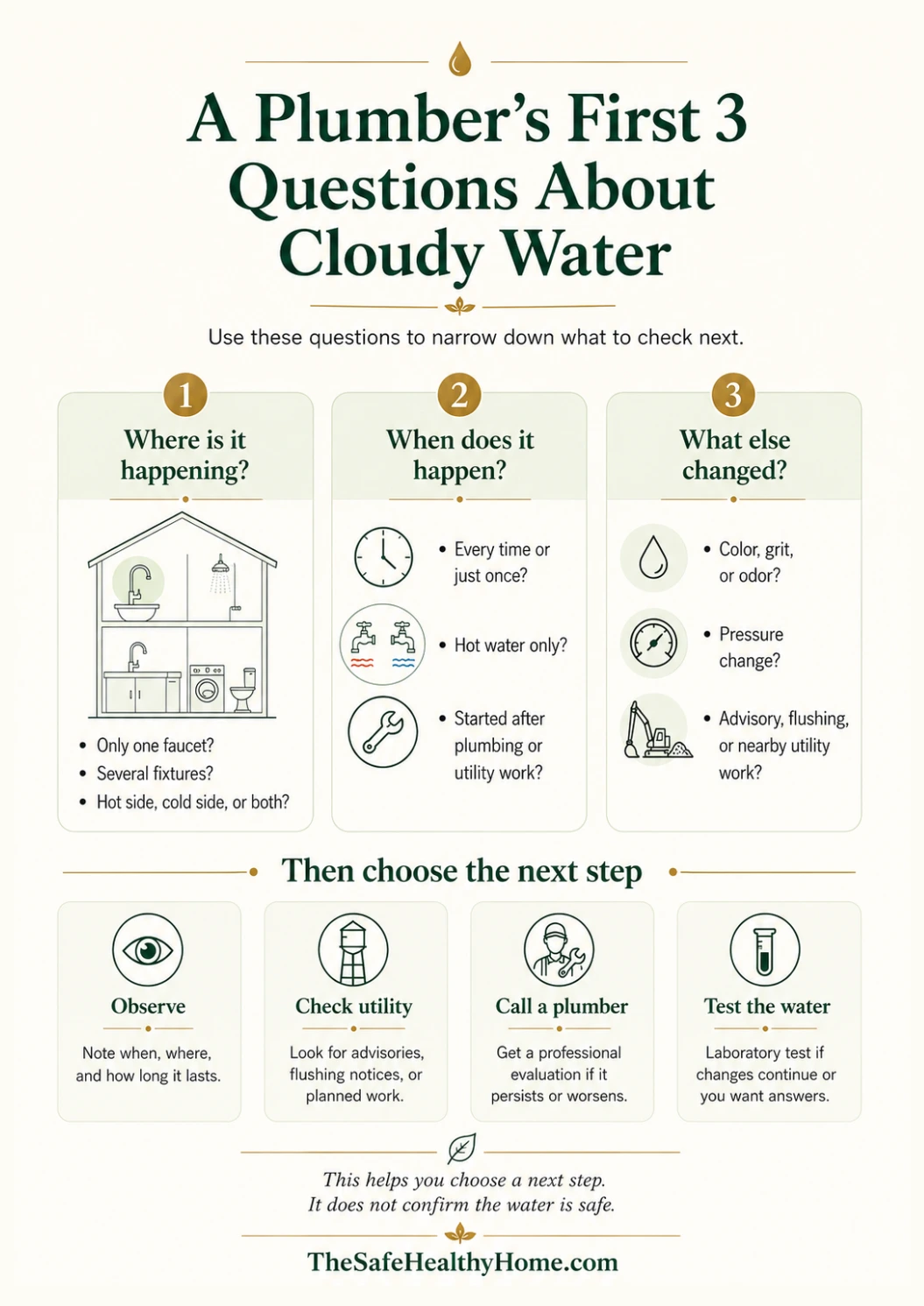
Jason Mondrosch, the licensed master plumber who reviewed this article’s plumbing guidance, described a common service-call pattern: a homeowner sees cloudy water at one bathroom sink and starts thinking about filters, water-heater work, or a whole-house water problem. The first questions are simpler: does the kitchen cold water do it, does another fixture do it, does the hot side do it too, and does it clear in a glass?
That does not prove the faucet is the cause, and it does not prove the water is safe. The lesson is not to make a whole-house decision from a one-faucet symptom.
If only one fixture keeps doing it, especially with odor, grit, color, or hot-only behavior, do not diagnose the exact cause from appearance. If the same issue shows up at several taps, contact the utility first. If it stays isolated to one fixture, one side of the system, or persists after the utility finds no issue, a qualified plumber may be the next call.
Why is only my hot water cloudy?
First check whether the cloudiness shows up only at the hot tap or at both hot and cold. Hot-only is a direction, not a diagnosis. It tells you to compare the hot and cold sides before assuming the whole supply is affected or jumping to a water-heater repair.
If only the hot water looks cloudy and it persists, compare more than one hot tap, ask whether the water heater or plumbing was recently serviced, and look for other symptoms such as odor, sediment, rusty color, pressure loss, temperature problems, or cloudiness that does not clear. If those signs show up, raise it with your water utility or a qualified plumber rather than guessing at a cause. This page does not pin hot-only cloudiness to a specific source.
Can I shower if my water is cloudy?
If the water fits the ordinary quick-clearing air-bubble pattern and there is no advisory, the cloudy appearance itself is not usually a reason to avoid showering. That still does not mean appearance proves safety; it means the visual pattern looks like trapped air.
If there is an advisory, color, odor, grit, persistent cloudiness, or uncertainty about what changed, follow local advisory guidance and contact the utility. Do not use a clear-looking glass as the deciding factor.
Should I call a plumber for cloudy water?
Start by sorting the pattern. Quick-clearing white or milky water from multiple taps, with no advisory and no other warning sign, usually fits the air-bubble pattern.
A simple way to think about it: utility first when the pattern looks supply-side; plumber next when the pattern stays inside the home.
Contact the water utility first if the water is persistent, colored, gritty, smelly, showing up across the whole home, affecting neighbors, following utility work, connected to pressure loss, or tied to an advisory. A qualified plumber may be the next call if the issue seems isolated to one fixture, one side of the system, recent work inside the home, fixture behavior, water-heater symptoms, or if it persists after the utility finds no supply issue.
The point is to choose the right next step, not to diagnose a plumbing cause from cloudy water alone.
Is cloudy water safe for my baby's formula?
Be conservative here. If there is any active advisory, or you are unsure why the water is cloudy, follow the advisory and do not judge safety by how the water looks. For broader safety and testing context, see our water-quality safety guidance, and raise any health-specific concern with your pediatrician.