
Legal limit
EPA’s enforceable standard tells you whether a public water system is meeting the law.
Water Quality Guide
A five-step process for understanding your tap water, reading your report, testing when it makes sense, and deciding whether treatment is actually needed.
Evidence-first. No scare tactics. No filter-first advice.
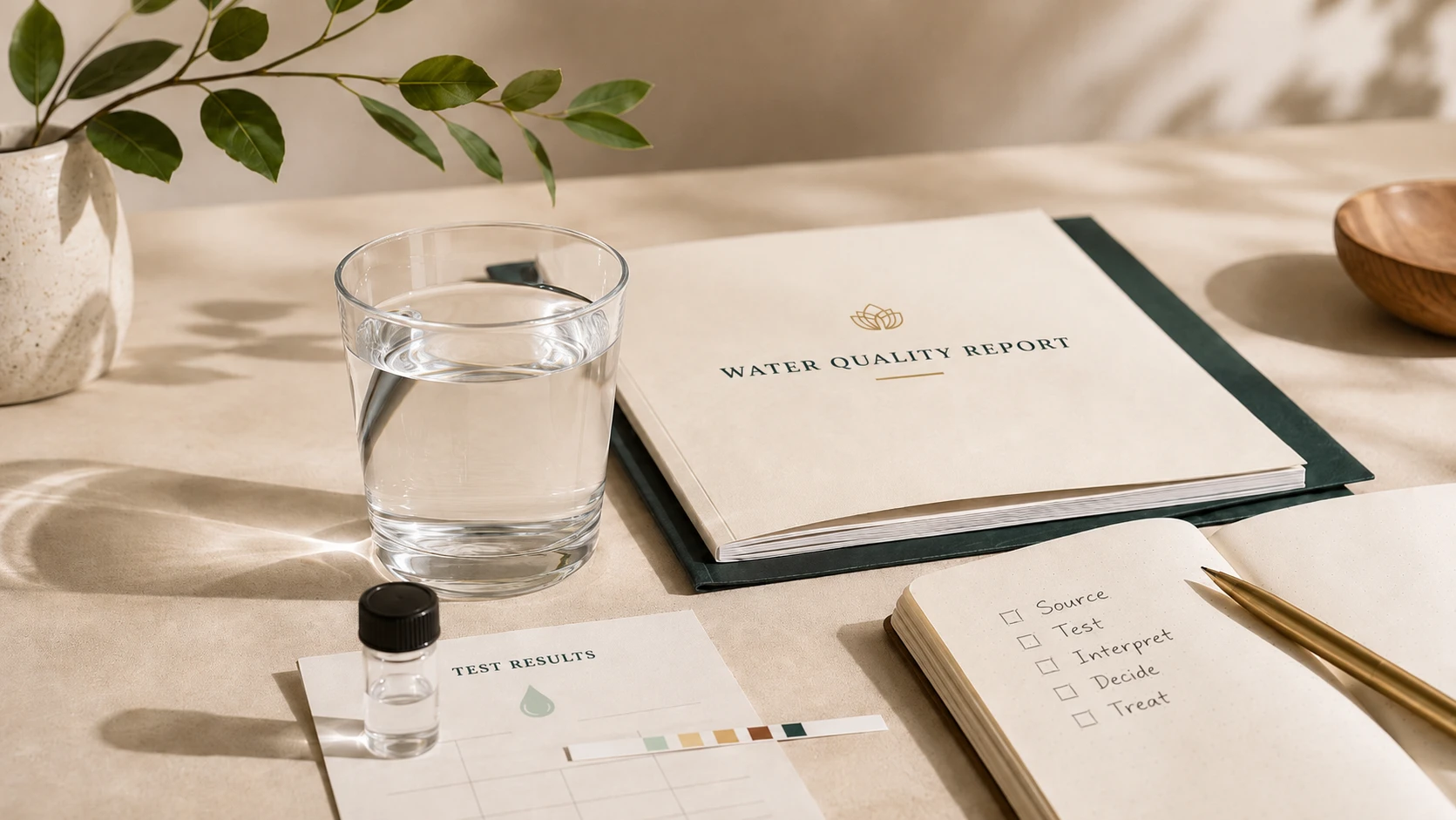
Most US tap water meets federal health standards. Your city and your home determine whether that general picture applies to you.
City, Pipes, and Your Tap
Home water quality means what’s in the water at your tap and whether it’s safe to use. Most US tap water meets federal EPA health-based standards, but quality varies by city and by your home’s plumbing. The way to know yours is to read your utility’s report and, if needed, test it.
Think of this page as a five-step path: where your water comes from, what is likely to be in it, how to check what is in yours, how to read the numbers, and what to do next. Start with the question you came here with, then follow the deeper guide when you need more detail.
Evaluate
Start with regulators and public-health sources, not filter marketing. Then separate two questions: does the water meet EPA’s enforceable legal limit, and does that limit match the stricter health goal? Most US tap water meets federal standards, but local conditions and household plumbing still matter.
EPA’s enforceable standard tells you whether a public water system is meeting the law.
The health-based goal can be stricter than the enforceable limit, especially for cancer-linked contaminants.
Your utility report is the baseline. Home plumbing can still affect what reaches your glass.
Our goal is not to make tap water sound scarier than it is, or safer than it is. We aim for a fair, evidence-based answer you can use.
The baseline. Start with the baseline, stated fairly. In 2023, about 96% of US public water systems recorded no violation of a federal health-based drinking water standard, according to EPA’s national compliance report; roughly 4% did. The same data shows about one in five systems had a monitoring or reporting violation, which doesn’t mean contamination but does mean the picture for those systems is less complete. So the baseline is reassuring, but not universal. Most public systems meet enforceable federal health standards. Your city and your home determine whether that general picture applies to you.
Legal vs. health — EPA’s two numbers. Next, separate two questions that get collapsed constantly. “Meets the legal limit” and “is best for health” are not the same thing, and EPA itself builds the difference into two numbers for most contaminants. The Maximum Contaminant Level (MCL) is the enforceable legal limit, set as close to the health goal as feasible after accounting for treatment technology and cost. The Maximum Contaminant Level Goal (MCLG) is the purely health-based target, set with a margin of safety and often at or near zero for substances linked to cancer. When those two numbers differ, the gap isn’t a loophole or an oversight. It’s the distance between the health target EPA would set on health alone and the limit it can actually enforce given today’s treatment technology and cost. That gap is where a lot of the confusion starts.
PFAS: a live example. PFAS, the “forever chemicals,” show how this works, and they’re a live case. In its 2024 rule, EPA set an enforceable limit of 4 parts per trillion for PFOA and for PFOS while setting the health goal for both at zero; the 4 ppt figure reflects what is currently measurable and feasible to regulate, not a level EPA calls risk-free. Worth noting: another federal science body, the ATSDR, sets health-based screening levels for these chemicals that work out higher than EPA’s 4 ppt limit, not lower, a useful reminder that “health-based” does not automatically mean “stricter.” As of June 2026, EPA has proposed to let eligible water systems request more time to meet the PFOA and PFOS limits, and to rescind limits for PFHxS, PFNA, HFPO-DA, and the Hazard Index mixture, but those changes are proposals, not final rules. EPA says the proposed rescission is based on a procedural flaw in how the 2024 rule was made, not on a reassessment of the underlying health-risk findings for those PFAS. Those 2024 limits still stand; only a final rule changes them, and the proposed deadline extension is a separate question from the limits themselves.
The order we weigh sources. That is the order we use. The EPA’s enforceable limit comes first, because it is the law. EPA’s health goal comes next, along with the World Health Organization’s guideline where the comparison is useful. On arsenic, for instance, the enforceable US limit and the WHO guideline land at the same number while EPA’s health goal is zero, which is mainly a feasibility difference, not a different view of the hazard. For certain contaminants, we also use ATSDR toxicology or CDC risk framing when those sources add something specific. For your own water, the most important document is local: your utility’s Consumer Confidence Report, which tells you what was measured where you live.
How we keep this honest. The goal is not to make tap water sound scarier than it is, or safer than it is. Alarmist filter marketing deserves skepticism, but so does the blanket claim that everything is perfectly fine. The test we use is simple: would both an EPA scientist and a mainstream toxicologist call this a fair representation of their position? If a sentence couldn’t pass that test, it doesn’t run. We use that same standard on the city guides and the deeper safety pages linked from this hub.
Most US tap water comes from either surface water (rivers, lakes, reservoirs) or groundwater (aquifers), treated by a local utility before it reaches you. What’s in it depends on your source, your region’s geology, the utility’s treatment, and your home’s pipes. Your city determines most of the answer.
Surface water and groundwater carry different risks. Surface sources are more exposed to runoff, agricultural chemicals, and seasonal change; groundwater more often picks up what’s in the local rock, like arsenic or radon. Your utility treats for these before the water leaves the plant, which is why the system-level picture is usually good. But what reaches your glass can differ from what left the plant, because the last stretch of pipe, your service line and your home’s plumbing, can add contaminants of its own, with lead the clearest example. That is why looking up your own city is usually more useful than reading national averages.
Start here if you want to understand how water gets from source to faucet
Private wells
Your water isn’t regulated by the EPA, and the testing and treatment story is different enough that this guide doesn’t cover it; we point well owners to dedicated guidance separately.
Two ways. First, read your utility’s annual water quality report, called the CCR, which lists what was detected and how it compares to legal limits; that covers water leaving the treatment plant. To check what reaches your own tap, including lead from home plumbing, use an at-home test kit or a certified lab.
These two methods answer different questions. The CCR tells you about the water your utility delivers to the neighborhood; it’s free, it arrives by July 1 each year, and it’s the right starting point for almost everyone. A home test tells you about your house specifically, which matters because the report can’t see your plumbing. It’s worth testing if your home predates the 1986 lead-free plumbing rules, if you have or suspect a lead service line, if the taste, smell, or color changed, or if your CCR flagged something you want to confirm at the tap. Match the test to the question: a broad screening kit for a general check, a certified lab for a result you intend to act on.
Start here if you need to find out what is actually in your tap water
A detected contaminant isn’t the same as an unsafe one. Reports compare your levels to the EPA’s enforceable limit, the MCL, and sometimes to its health goal, the MCLG. When those numbers differ, a report can be legally reassuring and still deserve a closer look.
Three different things get read as the same thing. A contaminant can be detected and well within the legal limit; it can exceed the health goal while still meeting the enforceable limit; or it can exceed the enforceable limit, which is a violation. Only the last is a failure against the law. The middle case is still worth noticing, though, because it means the contaminant is below the enforceable limit but above the health goal.
Lead is the exception
Lead is the important exception, and the place “my city meets standards” can mislead. Lead isn’t governed by a health-based MCL at the treatment plant; it’s controlled through a treatment technique and action-level framework. Under EPA’s newer Lead and Copper Rule Improvements, the lead action level is 10 parts per billion, with full compliance requirements still phasing in.
The key point is that the action level is measured at the 90th percentile across sampled taps: up to 10% of sampled taps can be above the action level without triggering a systemwide action-level exceedance. And because lead mostly enters after the water leaves the plant, from lead service lines and older household plumbing, your neighbor’s safe result and yours can differ on the same water main. A clean city report is necessary but not sufficient evidence about your specific tap.
Start here if your tap water looks cloudy or milky
For most US households on a compliant public system, with no lead plumbing and no specific local issue, tap water is safe to drink and a filter is optional rather than required. The honest answer is conditional: it depends on your city, your home’s pipes, and which contaminant, if any, you’re addressing.
This is the question the whole water section is built to answer, and it does not have a one-word answer. Start from the baseline, apply the legal-versus-health distinction to your own city’s report, and check your home for lead risk, and you’ll usually find that treatment is a preference rather than a necessity.
Start here if you are unsure whether your water needs treatment
Match the treatment to the specific contaminant, because no single filter removes everything. A carbon pitcher that improves taste and cuts chlorine is the wrong tool for arsenic or nitrate, while reverse osmosis that strips out nearly everything may be more than a chlorine complaint calls for. Choose by what you’re trying to remove.
Verify rather than trust the label. A product earns NSF/ANSI certification for the specific contaminant you care about, and that certification, not the marketing on the box, is what tells you it does the job.
Start here if you know the concern and need the right filter