
Water Quality Basics
What Is Tap Water?
Tap water is water from a faucet, but where it comes from and what reaches your glass depends on your water source, local system, pipes, and home plumbing.

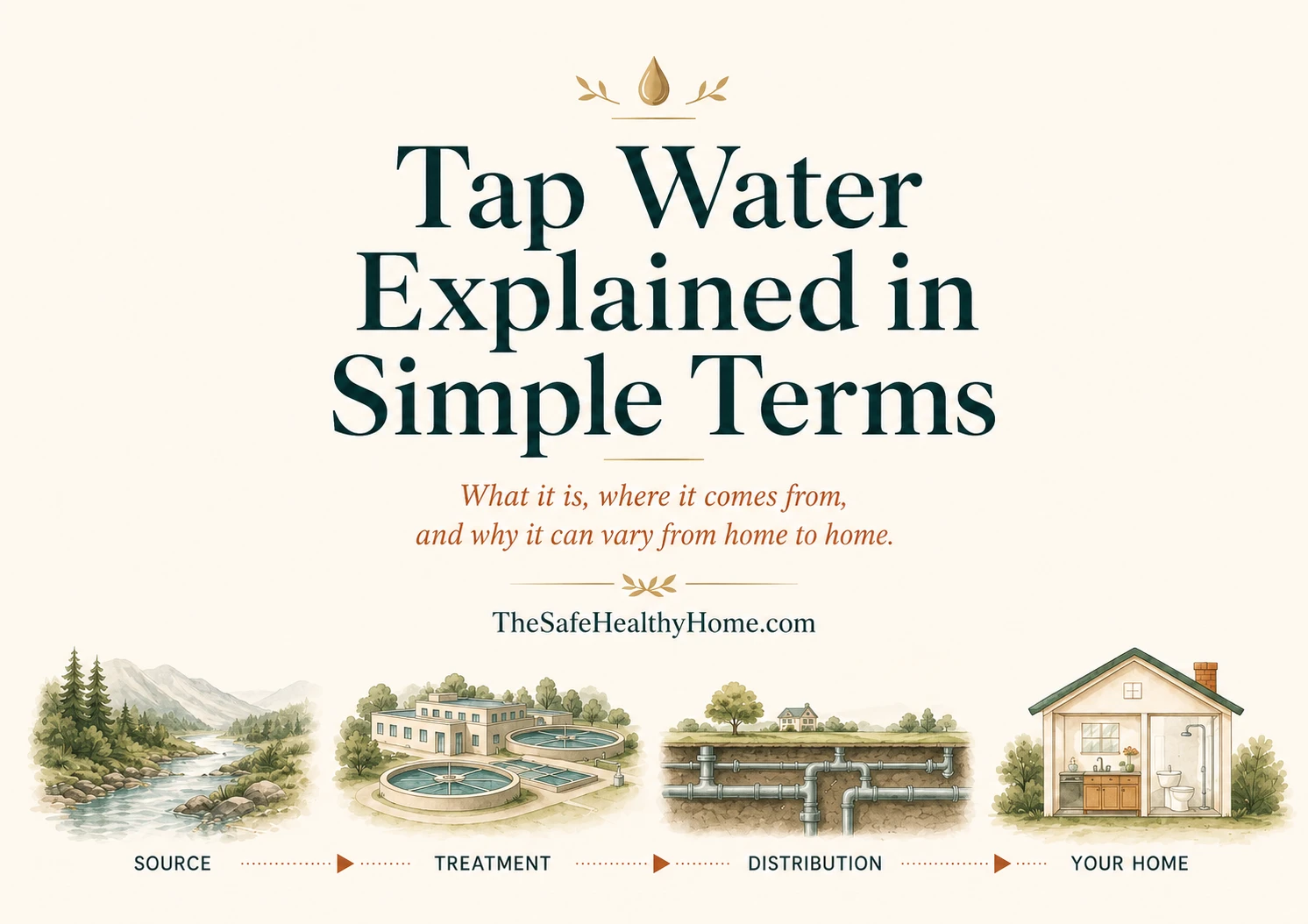
Tap water is the water that comes out of a faucet or tap. In the US, it usually comes from a public water system or a private well. What reaches your glass depends on where the water starts, how it is treated, the pipes that carry it, and your home’s plumbing. (Merriam-Webster)
This guide starts with the plain meaning, then explains the source, system, and household factors that determine what actually reaches the faucet. The point is to give you a simple mental map for understanding the water you already use every day.
What does “tap water” mean?
“Tap water” means water that comes from a tap, usually inside a home, school, workplace, or other building. It is also often called faucet water, sink water, running water, or piped water.
People use these words casually, which is why the question can get confusing. Most of the time, you do not need to separate them perfectly. If someone says faucet water or sink water, they usually mean tap water. Running water usually means water that is available through indoor plumbing, rather than carried in from somewhere else. Piped water focuses on the delivery system: water moving through pipes, whether that system is public, private, large, or small.
Municipal water is a little more specific. In everyday use, it usually means water supplied by a city, town, or local water provider. But not all tap water is municipal water. A rural home with a private well can still have tap water because the water comes out of a faucet, even though it does not come from a city water system.
Drinking water is related, but it is not identical. Tap water is often used as drinking water, especially in homes served by public water systems in the US. But “drinking water” describes intended use, while “tap water” describes how the water is delivered.
Where does tap water come from?
Tap water begins as source water. EPA describes source water as water from places such as rivers, streams, lakes, reservoirs, springs, and groundwater that supply public drinking water systems and private wells. (EPA)
At a beginner level, there are two main source categories.
Source category
Surface water
comes from rivers, lakes, reservoirs, and similar above-ground sources. A city might draw water from a large reservoir, a nearby river, or a connected system of lakes and streams.
Source category
Groundwater
is water stored underground in aquifers. It can be pumped through wells. Some public water systems use groundwater, and private wells usually do too.
CDC summarizes the household path simply: most US tap water comes from reservoirs, lakes, rivers, or underground water, and it usually reaches the tap through a local water system or a private well. (CDC)
The source is the starting point, not the whole answer. A mountain reservoir, a river system, and an underground aquifer can each have different natural minerals, seasonal patterns, and treatment needs. But water can also change after it leaves the source. That is why it helps to think about the whole path from source to faucet.
How does water become tap water?
For most homes on a public water system, tap water goes through a basic path before it reaches the faucet. The faucet is the visible part. To understand the water itself, it helps to look at the steps before that point.
Source water is collected
A public water system first draws water from its source. That source might be a river, lake, reservoir, spring, or groundwater supply. The source matters because it shapes what the system has to manage before the water reaches homes.
EPA describes source selection, source protection, treatment, and distribution-system protection as parts of a broader approach to drinking-water safety. (EPA)
Public water systems treat and monitor it
Public water systems treat water before sending it into the distribution system. CDC explains that public water systems treat water to remove germs and chemicals and to meet EPA standards. (CDC)
Treatment is not the same in every place. A system using surface water may need different treatment than a system using groundwater. A small town, a large city, and a regional water supplier may also manage water in different ways.
Water moves through distribution pipes
After treatment, water travels through a distribution system. This is the network of mains, storage tanks, pressure zones, service lines, and smaller pipes that carry water toward homes and buildings.
This part of the journey is easy to ignore because it is mostly underground. But it is part of what makes tap water different from “water at the treatment plant.” EPA’s source-water framework includes distribution-system protection, not just treatment at the start. (EPA)
Home plumbing is the final step before the faucet
The last part of the journey is your own building. Water passes through the service line, household pipes, fixtures, and faucet before it reaches your glass.
That is why two homes on the same public system may not have identical tap water at the faucet. The public system matters, but the building matters too.
Public tap water vs private well water
The biggest US distinction is public tap water versus private well water.
In plain English, the question is whether a regulated water system is responsible for the water before it reaches your building, or whether the water comes from a private well that the household owner is mainly responsible for.
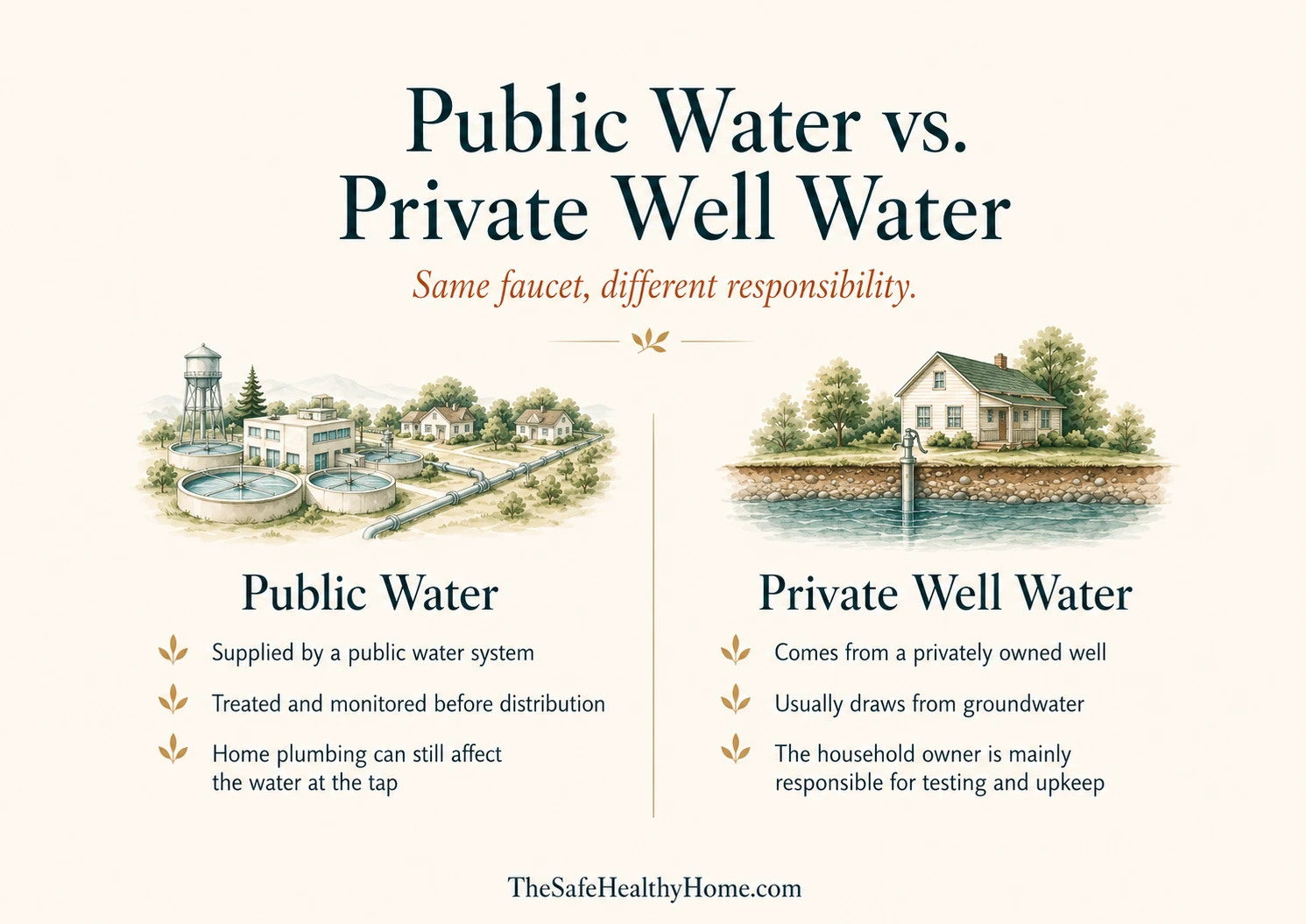
A public water system provides water for human consumption through pipes or other constructed conveyances to at least 15 service connections, or serves an average of at least 25 people for at least 60 days a year. EPA says public drinking water systems regulated by EPA, states, and tribes provide drinking water to 90 percent of Americans. (EPA)
EPA classifies public water systems into different types. A community water system serves the same population year-round, which is the category most people mean when they talk about city water or household public water. Other public systems may serve schools, factories, hospitals, campgrounds, gas stations, or other places where people may not live year-round. (EPA)
Private wells are different. EPA says private well owners are responsible for delivering safe drinking water to their households, and that private domestic wells are not regulated by the federal government under the Safe Drinking Water Act. EPA also estimates that around 15 percent of the US population, more than 43 million people, rely on private wells as their drinking-water source. (EPA)
This is not a “which is better” distinction. Public water and private well water can both come from groundwater. Both can come out of a faucet. The important difference is responsibility. A public system is regulated and monitored through public drinking-water rules. A private well is mainly the owner’s responsibility.
Why tap water is not the same everywhere
Tap water varies because the path behind the faucet varies from place to place, and sometimes from home to home.
Start with the source. One city may rely on reservoirs. Another may draw from a river. A rural home may use groundwater from a private well. The source shapes the starting point.
Treatment also differs by system and source. A public water system treats water based on its source water, the standards it must meet, the equipment it uses, and the conditions it manages through the year.
Distribution pipes can matter too. After treatment, water still has to travel through a network before it reaches homes and buildings. That network can be old, new, large, small, simple, or complex.
Your home plumbing can matter. Water from the same public system can pass through different service lines, pipes, fixtures, and faucet materials before it reaches the faucet. That final step is one reason a city-level answer does not always settle a household-level question.
Taste, smell, hardness, and appearance can also vary. Some changes are noticeable but mainly aesthetic. Others deserve a closer look. CDC notes that a change in taste, color, or smell is not necessarily a health concern, although it can sometimes signal a problem. (CDC)
That is the key idea: tap water is local, and it is also household-specific. You do not need to become a water-system expert to understand your own tap water, but you do need to know that the answer is partly about your location and partly about your home.
Is tap water the same as drinking water, filtered water, bottled water, or well water?
These terms often get used together, but they answer different questions. Some describe delivery. Some describe the source. Some describe an added process or how the water is packaged.
| Term | What it means |
|---|---|
| Tap water | Water that comes out of a faucet or tap. It may come from a public water system or a private well. |
| Drinking water | Water intended for drinking. Tap water describes delivery, while drinking water describes intended use. |
| Municipal water | Water supplied by a city, town, or local water provider. It is a common type of tap water, but not all tap water is municipal. |
| Private well water | Water from a privately owned well, usually groundwater. It can be tap water if it comes through household plumbing and out of a faucet. |
| Filtered water | Water that has passed through a filtration step. It may start as tap water, but filtering is an added process. |
| Bottled water | Water packaged and sold in bottles. It may come from different sources, including municipal supplies in some cases, but it is regulated and sold as a packaged product rather than delivered through your home faucet. |
| Distilled water | Water that has been evaporated and condensed through distillation. It is not what people usually mean by tap water. |
The main point is that “tap water” tells you how the water reaches you. It does not automatically tell you whether the water is municipal, from a private well, filtered, bottled, or distilled.
Does tap water mean the water is safe to drink?
“Tap water” describes delivery, not a full safety verdict. It tells you the water comes from a faucet. It does not, by itself, tell you everything about the water source, treatment system, distribution pipes, home plumbing, or private well status.
In many US homes on public systems, tap water is treated and regulated. CDC says 9 out of 10 people in the United States get tap water from a public water system, and public systems must meet EPA drinking-water standards. (CDC)
That is useful context, but it is still not the same as knowing what is true at your own faucet. For the full safety framework, read our guide to is tap water safe to drink.
How to understand your own tap water
Start with one basic question: are you on a public water system or a private well?
Public water
If you are on public water, identify the water system or local water provider that serves your address. That may be listed on your water bill, your city or county website, or your landlord’s information if you rent. If you are served by a community water system, look for its annual water quality report, also called a Consumer Confidence Report. EPA says these reports provide information about local drinking water quality. (EPA)
Private well
If you are on a private well, the starting point is different. The water may still come out of your tap, but there is no public water system managing it in the same way. EPA says private well owners are responsible for safe drinking water in their households. (EPA)
From there, keep the framework simple: know the source, know the system, and know whether your building adds an important household-specific question. Then decide whether you need more information.
For the broader decision path, start with our home water quality guide. It walks through source, checking your own situation, understanding what you find, deciding whether action is needed, and choosing a treatment path only when that step is relevant.
The simplest way to think about tap water
Tap water means faucet water. That part is simple.
The fuller answer is that tap water has a path behind it. In the US, it usually reaches a home through a public water system or a private well. Before it reaches your glass, it may pass through a source, a treatment process, a distribution system, and your own plumbing.
So when someone asks “what is tap water?” the best answer is not just “water from the tap.” It is water from the tap, shaped by the source, the system, the pipes, and the home it travels through.
Common tap water questions
What is considered tap water?
Tap water is water that comes out of a faucet or tap. It may come from a public water system, a smaller shared system, or a private well if that water reaches the home through plumbing.
Where does tap water come from?
Tap water usually starts as surface water or groundwater. Surface water can come from rivers, lakes, or reservoirs. Groundwater comes from underground aquifers and wells. From there, water may move through a public system or a private well before reaching the faucet.
Is tap water the same as drinking water?
Not exactly. Tap water describes how water is delivered. Drinking water describes water intended for drinking. In many US homes, tap water is used as drinking water, but the two terms do not mean the same thing in every context.
Is tap water always municipal water?
No. Municipal water usually means water supplied by a city, town, or public utility. Tap water can also come from a private well, especially in rural homes.
Is well water considered tap water?
It can be. If well water comes through household plumbing and out of a faucet, it is tap water. The difference is that private well water is usually the homeowner’s responsibility, not a public utility’s.
Does tap water mean it is safe to drink?
Not by itself. “Tap water” tells you the water comes from a faucet, not whether it is safe in every situation. In many US homes on public systems, tap water is treated and regulated, but the full answer depends on the water system, source, pipes, plumbing, and whether the home uses a private well.
Is tap water filtered?
Not always in the way people usually mean. Public tap water is treated before it reaches homes, and some systems use filtration as part of that process. But that is different from saying the water is filtered at your faucet or through a home water filter.