
Home Cleaning Basics
Homemade Lemon Cleaner: Lemon Vinegar Spray and Lemon Essential Oil Uses
An honest guide to the homemade lemon cleaner: what it cleans well, the surfaces it can quietly damage, and what lemon essential oil does and does not do.

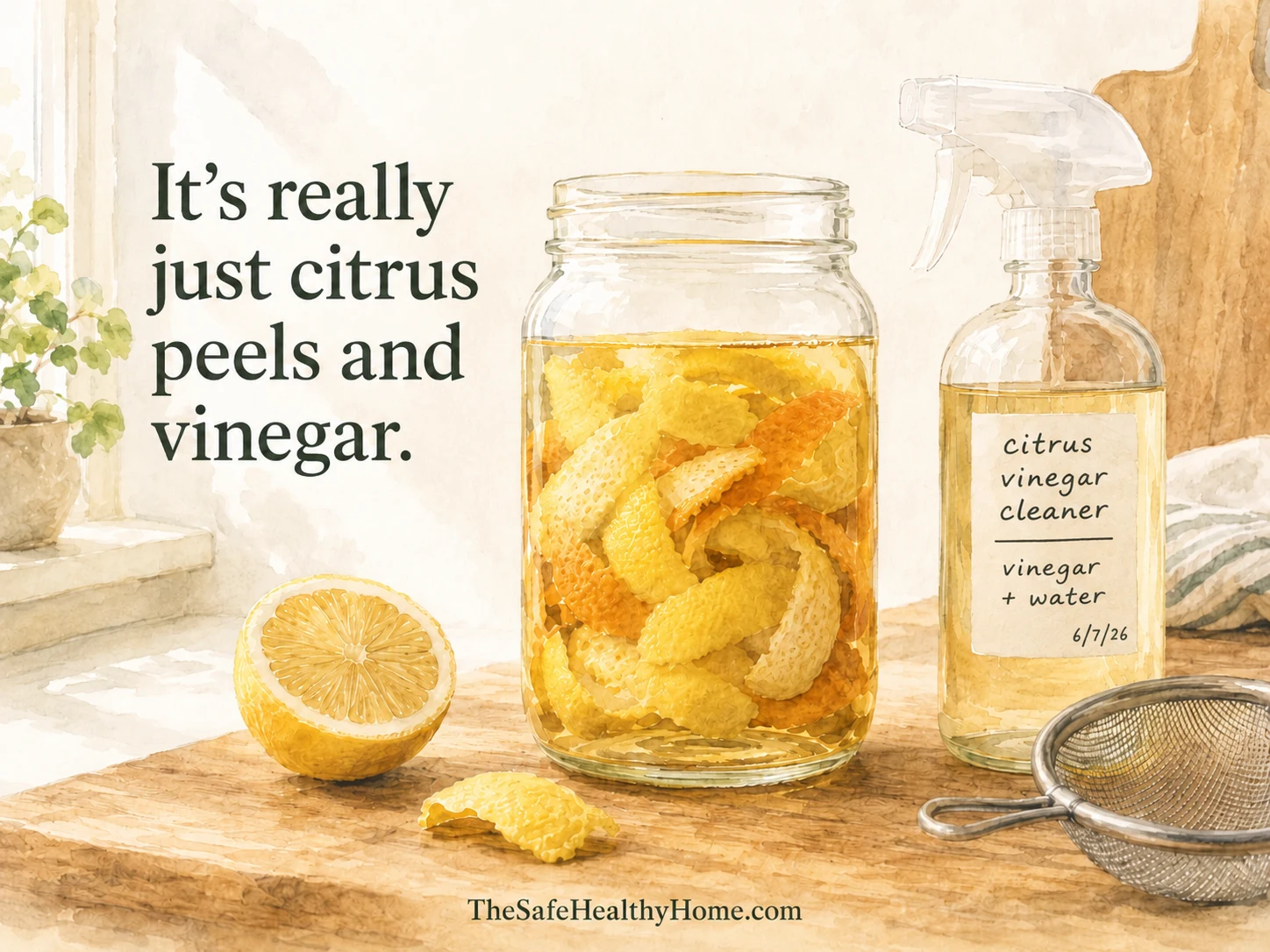
A homemade lemon cleaner is really a citrus-infused vinegar spray. It is a light-duty acidic cleaner with a more pleasant smell than plain vinegar. Use it for everyday wiping on certain washable surfaces. It is not an all-purpose cleaner or a disinfectant. It can help with fresh splatters and light greasy film, but it is not a heavy-duty degreaser. Lemon essential oil fits in too, mostly as an optional scent.
How to make a homemade lemon vinegar cleaner
The method is simple: steep citrus peels in vinegar, strain, dilute, and label. The peels add scent. The vinegar does the cleaning.
What you need
You need lemon peels, plain white distilled vinegar, a clean wide-mouth glass jar, a fine mesh strainer, and a spray bottle. Orange peels work too, on their own or mixed with lemon. Smaller batches are easier to strain and easier to use up before you stop trusting them.
A note on the jar lid. Vinegar is acidic and can corrode or discolor a metal lid over weeks of contact. I use a glass jar and prefer a plastic lid, or I put a layer of parchment or plastic wrap between the vinegar and a metal lid.
Steep, strain, dilute
Loosely pack the peels into the jar and cover them completely with white distilled vinegar. Let it steep for about two weeks. That is long enough for the vinegar to pick up a citrus smell without the project becoming fussy. Two weeks is a common pattern in citrus vinegar recipes, not a precise rule.
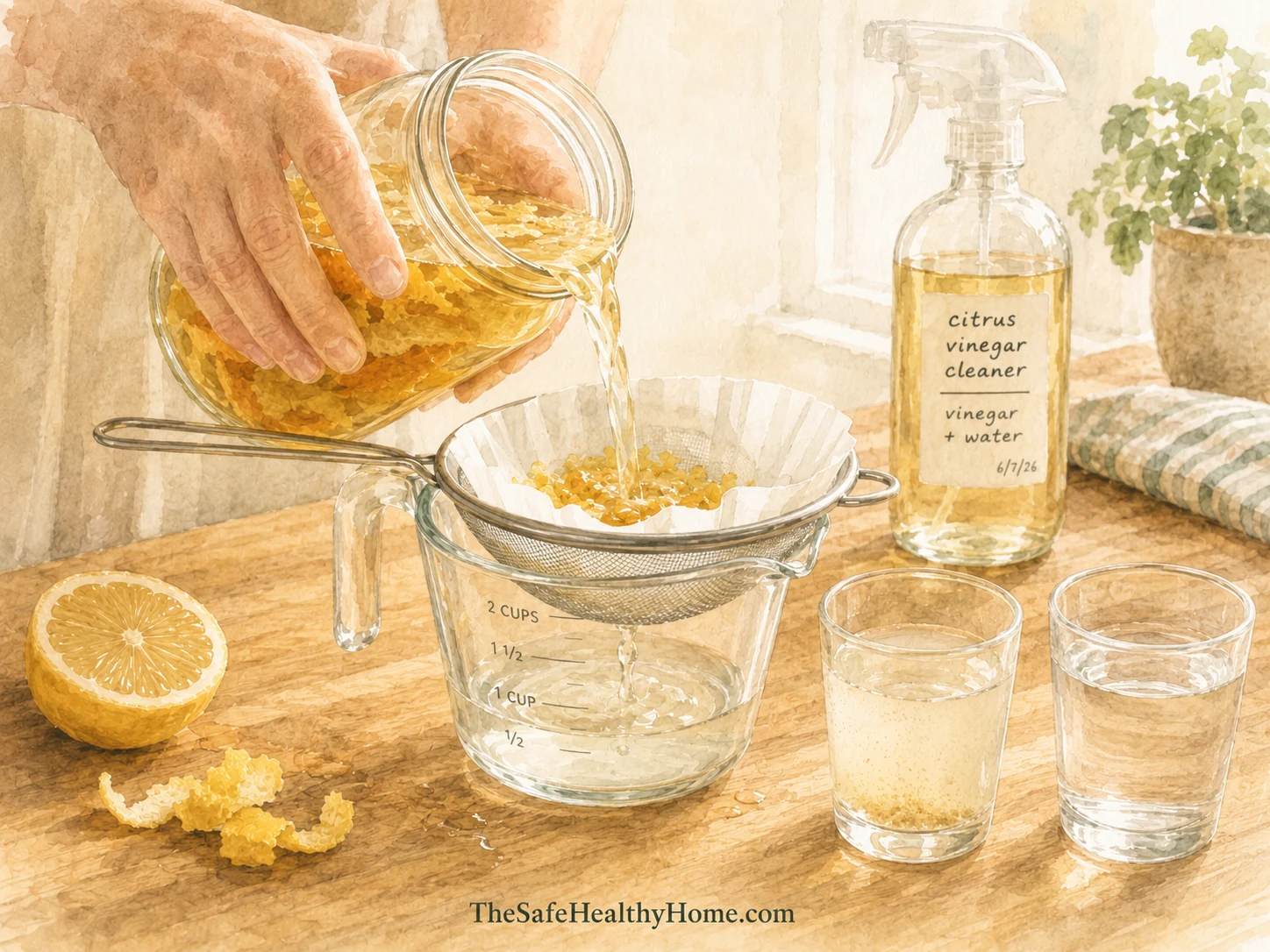
Treat the steeped vinegar as a concentrate, not the finished spray. Strain out the peels, then dilute the strained citrus vinegar with an equal amount of water. In a 16-ounce bottle, that is about 1 cup citrus vinegar and 1 cup water. A 1:1 dilution is easier to live with day to day, because the vinegar smell is milder than full strength. Some recipes use the infused vinegar straight and some dilute it more, so adjust by the job instead of locking onto one ratio.
For everyday wiping, the 1:1 spray is enough. For something like mineral buildup near a faucet, and only if the fixture finish can tolerate vinegar, you can use the infused vinegar stronger for a short contact time, then wipe and rinse. Stronger is for a short, targeted job, not for spraying everything.
A quick word on the water you dilute with. Plain tap water is fine here. You do not need distilled or filtered water to make a cleaning spray. If your home has hard water, that mineral content is also what leaves the chalky buildup around faucets and fixtures, which is exactly the kind of spot where a stronger citrus vinegar spray earns its place. What is actually in your tap water, and how hard it is, is a separate question worth knowing if you also drink from the tap. For that, our home water quality page walks through a five-step process for understanding what's in your tap water.
Strain it well
This is the step most people rush, and it caused my most common problem. Small bits of pulp and peel slipped through the mesh strainer, the liquid looked cloudy, and the spray bottle sputtered instead of misting. Strain it better than you think you need to. If the liquid still looks cloudy after the mesh strainer, run it through a coffee filter, a thin towel, or a cloth before it goes in the sprayer. Clogged sprayers are one of the most common practical complaints with citrus vinegar cleaner, and careful straining is the fix.
Lemon essential oil vs lemon juice vs lemon-peel vinegar
These three are not interchangeable, and most recipe pages blur them together. They play three different roles.
Lemon-peel-infused vinegar is the cleaner in this guide. The vinegar does the acidic cleaning work, and the peel adds a citrus smell.
Lemon essential oil is a concentrated aromatic compound pressed from the peel. In a homemade vinegar spray it is best treated as an optional scent addition, not the ingredient doing the cleaning. It does not turn a cleaner into a sanitizer or a disinfectant, because the EPA treats sanitizing and disinfecting as regulated claims, separate from ordinary cleaning. If you want to add it, keep it modest, about 5 to 10 drops in a 16-ounce bottle, and shake before use. I am more cautious with it than I used to be. Too many drops made the smell linger longer than I wanted, and adding it to an already citrus-infused vinegar is overkill. The peel infusion has usually done the scenting already.
Lemon juice is a third thing. It is acidic, but it is not the same as essential oil or peel-infused vinegar. I use it for short, rinse-afterward jobs, like freshening a sink before washing it properly. I do not keep it in a spray bottle. It can leave a sticky film and smell stale rather than fresh.
Where lemon vinegar cleaner works, and where it does not
Match the cleaner to the surface. It belongs on washable, non-stone surfaces, used lightly and wiped off rather than left to dry.
| Good for light wiping | Avoid |
|---|---|
| Sink area, faucet area, fresh stovetop splatters, fridge handles, trash-can exterior, ceramic tile, some bathroom sink areas, occasional glass or mirror touchups | Marble, limestone, travertine, and other natural stone; wood floors and waxed wood; electronics and screens; cast iron; knives; delicate or manufacturer-finished surfaces |
Even on reasonable surfaces, spray lightly, wipe it off, and test first if the finish is unfamiliar.
The stone column matters most. Products containing lemon, vinegar, or other acids can dull or etch calcareous stone such as marble, limestone, and travertine, because that stone is mostly calcium carbonate and reacts with acid. This is where "natural" advice can turn into expensive damage, so a neutral cleaner is the right tool for stone. I have not tested this spray on marble, and I would not.
The other surfaces on the avoid list are about acid, moisture, and finishes. The acidity in vinegar can damage wood floors and their finish over time, and waxed wood needs wax-compatible care. Apple advises against household cleaners on screens, and the same caution fits electronics generally. Cast iron, knives, and manufacturer-finished appliances should follow the maker's care instructions, not an acidic homemade spray.
On a stainless steel sink basin I have had mixed results. It can lift dull water spots, but it can also streak if I use too much or let it dry. The fix that works for me is to spray lightly, wipe, follow with a damp cloth, and dry with microfiber. I go easier on stainless appliances and coated finishes than on a plain sink basin.
On grease, keep expectations modest. This spray helps with fresh stovetop splatters, light greasy fingerprints, and small sticky spots that have not hardened. It is not a heavy-duty degreaser. Baked-on grease, old cabinet grime, and range-hood film need a surfactant, soaking time, or a dedicated product. A few drops of dish soap in the bottle can help on greasy fingerprints, but then it needs rinsing or a follow-up damp wipe, so I do not treat that as a no-rinse default.
Cleaning vs sanitizing vs disinfecting
These are three different jobs. The EPA separates cleaning from sanitizing and disinfecting. Cleaning removes dirt and germs from a surface, while sanitizing and disinfecting are regulated germ-reduction or germ-killing claims. A homemade citrus vinegar spray is a cleaner. It is not an EPA-registered disinfectant product, and it should not be described as one.
For most households, that distinction matters less than it sounds. The CDC notes that regular cleaning is enough in most home situations, and that disinfecting is more relevant when someone is sick or at higher risk of infection. When you do need to disinfect, that is a job for a product with a registered disinfectant label, used for the contact time on the label, not a homemade spray.
This is also why this site avoids words like "non-toxic," "chemical-free," and "disinfecting" for homemade cleaners. Vinegar is acid. Lemon juice is acid. Essential oils are concentrated fragrance compounds. Calling any of them "chemical-free" is inaccurate, and calling a homemade spray a disinfectant overstates what it does. "Light-duty citrus vinegar cleaner" is less exciting and more honest.
Using it safely
Homemade does not mean low-risk. A homemade cleaner still needs a label, sensible storage, ventilation, and surface judgment.
Never mix it with bleach or other cleaners
This is the safety rule that matters most. Health Canada warns that bleach reacts with acids like vinegar to create toxic gases. Never combine a vinegar or lemon cleaner with bleach, and never mix random cleaning products together hoping for a stronger result. The safe habit is to use one cleaner at a time, keep each product in its own bottle, and rinse a surface before switching to a different product.
Do not combine vinegar and castile soap in one bottle
Vinegar and castile soap are both useful, but not together. Vinegar is an acid and castile soap is a base, so vinegar and castile soap cancel each other out, leaving a curdled, oily mess instead of a better cleaner. If you want a soap cleaner, make a soap-and-water cleaner. If you want an acidic cleaner, keep it as vinegar and water. One bottle does not need to do everything.
Fragrance, ventilation, and people who are sensitive
Scent is not free. Cleaning products release volatile organic compounds that can irritate the eyes, nose, and throat and cause headaches, which is why ventilation and following label directions matter. A "natural" or "green" label is not automatically safer. In practice, I spray less, avoid spraying into the air, and open a window. If someone in the house is sensitive to strong smells, I skip the essential oil entirely.
Pets, especially cats
Be careful with fragrance around animals. Pet Poison Helpline lists citrus oils, including d-limonene, as toxic to cats, in part because cats lack a liver enzyme they need to break these compounds down. If cats are in the area, skip the essential oil, and store and use the spray where pets are not exposed. A homemade spray is not "pet-safe" just because the ingredients sound familiar.
Storage, labeling, and how long a batch lasts
Treat the bottle like a cleaning product, not like something harmless. Label it with what is inside, such as "citrus vinegar cleaner, vinegar and water," and add a date when you remember. Poison control centers advise labeling cleaners clearly and keeping them out of reach of children, away from food and never in food or drink containers, because food-scented products are easy to mistake for something drinkable. I keep mine in a cleaning area, not near food, and I make smaller batches so a jar does not sit around indefinitely. I have not measured a precise shelf life, so when a batch looks cloudy or smells off, I make a fresh one.
Common questions
Do I need lemon essential oil?
No. The peels scent the vinegar on their own. Essential oil is optional, and it is for smell, not cleaning power.
Does it disinfect?
No. It is a cleaner, not a registered disinfectant. For most homes, regular cleaning is enough, and disinfecting is a separate job for a labeled disinfectant product.
Can you combine lemon juice and vinegar for cleaning?
I would not make a stored cleaner out of lemon juice and vinegar. They are both acidic, and combining them does not add much for everyday cleaning. Lemon juice can turn sticky and stale in a stored bottle, so peel-infused vinegar is the more practical choice.
What happens if you mix hydrogen peroxide and lemon juice?
Keep cleaning products separate rather than combining them in one bottle. Use one at a time, and rinse a surface before switching products. The genuinely dangerous combination to avoid is bleach with any acid such as vinegar, which can release toxic gas.
What is the vinegar-to-water ratio?
A 1:1 mix works for everyday wiping, about 1 cup citrus vinegar and 1 cup water in a 16-ounce bottle. Use it stronger only for a short, targeted job, then wipe and rinse.