
Healthy Kitchen Basics
Is Homemade Bread Healthier?
You'd expect a homemade loaf to be the lighter, cleaner choice. Often it is. But a dense slice from your own oven can carry more calories than the packaged bread you were avoiding, and which way yours goes is mostly up to you.

Homemade bread can be healthier, but the difference comes down to what you make it with, how you ferment it, how much you eat, and how it compares with the bread you would otherwise buy.
Here is the direct answer. Yes, homemade bread can be healthier than store-bought bread. It is not healthier automatically. The real advantage is not some quality in the act of baking at home. It is control. When you make your own bread, you decide the flour, the salt, the sugar, the fats, the fermentation, and the size of the slice. That control is what creates the opportunity for a healthier loaf. It does not guarantee one. Where this guide makes a claim, it leans on federal nutrition guidance and compares homemade against the bread you would otherwise buy.
It helps to start with why people bake at home in the first place. There is the smell of a loaf coming out of the oven, the crackle of the crust as it cools, and the simple satisfaction of having made something with your hands. There is also the comfort of knowing exactly what went into it. Those reasons are real and they are enough on their own. This article is about a narrower question: when you set the warm feelings aside, is the bread actually better for you? The answer is that it can be, and below is what decides it.
The real difference is control
Bread is built from a short list of variables. Flour. Water. Salt. Yeast or a sourdough starter. Time to ferment. Often a little sugar or fat. And then portion size, which most people forget is part of the recipe.
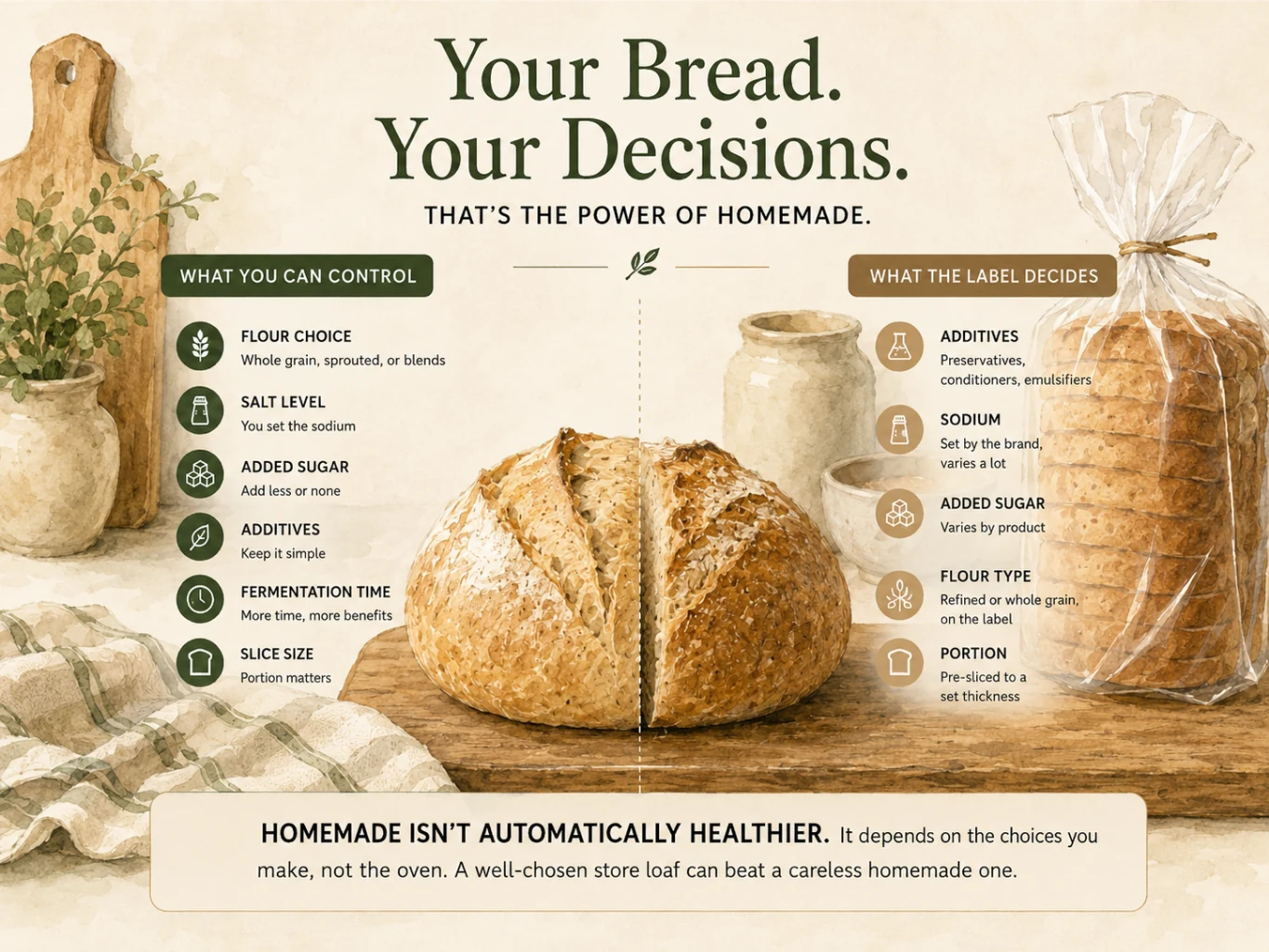
At home, every one of those is a dial you can turn. You can move the flour toward whole grain. You can measure the salt instead of inheriting it. You can leave out sugar a loaf does not need. You can let the dough ferment longer if you want to. You can cut a sensible slice.
When I bake, that control is less neat than it sounds on paper. A dough at about 65% hydration feels firm and easy to shape. Push the same flour closer to 75%, and it starts to feel looser and more alive, which can be great if you want a chewier, more open loaf. Swap in whole wheat and the numbers change again, because whole wheat absorbs more water than white flour. That is the real kind of control home baking gives you. It is a set of choices you learn by feel, not one setting you choose once.
With store-bought bread, you do not turn those dials directly. You choose by reading the label and picking the loaf that already matches what you want. That is still a real choice, and a well-chosen packaged loaf can beat a carelessly made homemade one.
The point is control. Homemade bread is not cleaner or safer in some inherent way. It is more adjustable. Whether that adjustability produces a healthier loaf depends entirely on the choices you make with it, which mostly come down to the things federal nutrition guidance already points to: whole grains, sodium, and added sugars.
Homemade bread vs store-bought bread
It is tempting to treat this as homemade good, store-bought bad. That is not how it works. Store-bought bread is not one thing. It ranges from ultra-soft white sandwich loaves to dense, fiber-rich whole grain breads with short ingredient lists. Homemade bread is not one thing either. A white homemade loaf is not automatically better than a strong whole grain loaf from a good bakery.
Here is a plain comparison of where the two usually differ, and what actually decides the outcome.
| Factor | Homemade bread | Store-bought bread |
|---|---|---|
| Flour and whole grains | You choose the flour and the whole grain percentage | Varies widely, from refined white to true whole grain |
| Fiber | Depends on your flour and add-ins | Depends on the product, often labeled |
| Sodium | You measure it directly | Set by the maker, can vary a lot between products |
| Added sugar | You can use little or none | Some loaves use very little, some use more |
| Additives and preservatives | Usually a shorter ingredient list | Often used for softness, shelf life, and consistency |
| Fermentation | You can ferment longer if you want | Usually optimized for speed and uniformity |
| Freshness and shelf life | Fresher, but goes stale or molds faster | Longer shelf life, often pre-sliced |
| Portion size | You slice it, for better or worse | Pre-sliced to a set thickness |
| Convenience | Takes time and effort | Ready to use, consistent every time |
No single column wins. The healthier loaf is the one with the better flour, reasonable sodium, modest added sugar, and a portion size that fits how you actually eat. That loaf can come from your oven or from the shelf.
Where homemade bread can be healthier
This is where baking your own genuinely pays off, and it lines up with why people enjoy it.
You can choose whole grain or partial whole grain flour, which is the single most useful upgrade most home bakers can make. You can measure salt on purpose rather than accepting whatever a recipe or a brand decided. You can limit or skip added sugar in everyday loaves. You can leave out ingredients you simply do not want in your kitchen. You can let the dough ferment longer for flavor and texture. And you can slice it the way you want instead of accepting a fixed thickness.
Put together, that is what makes home baking a more mindful kitchen habit. You are paying attention to what goes into a food you eat often. That attention is the real benefit.
The important nuance is that this is practical food control and nothing more. A homemade loaf is healthier when you use that control well.
Where homemade bread can still fall short
It is just as easy to bake an unhealthy loaf at home as it is to buy one.
If your homemade bread is mostly refined white flour, it is not meaningfully better for you than refined white bread from a store. The same goes for a loaf that is high in salt, heavy on added sugar, or enriched with a lot of butter or oil. The enriched loaf my family asks for most has milk, butter, eggs, and a real spoon of sugar. It is wonderful, and I do not pretend the homemade label launders the butter out of it. I think of that kind of loaf as weekend bread, not the bread that proves a health point. Sweet breads and rich enriched loaves are lovely, but they are closer to a treat than a staple, whether you make them or buy them.
Two corrections, because the homemade label tends to hide them:
Homemade bread is not automatically lower in calories, and it is not automatically lower in carbohydrate. A dense, hand-shaped loaf can actually carry more calories per slice than thin packaged sandwich bread, simply because the slice is bigger and the crumb is tighter. Portion size still matters, and a generous homemade slab counts as more than one polite serving.
This is the health halo effect. The word homemade makes food feel virtuous, which makes it easy to eat more of it and to assume it is doing more for you than it is. The bread does not know it was made at home. Only the ingredients and the amount you eat actually matter.
Flour choice, whole grains, and enriched bread
If health is the goal, flour is where most of the real difference lives.
White or refined flour is milled to remove the bran and germ, leaving mostly the starchy endosperm. That gives a soft, light crumb, but it also removes much of the fiber and many of the nutrients that live in the outer layers of the grain.
Enriched flour is refined flour that has certain nutrients added back, often B vitamins such as thiamin, riboflavin, niacin, and folic acid, along with iron. That matters, because it means enriched flour is not nutritionally empty. It is a real source of some nutrients. What enrichment does not do is rebuild the fiber and the original structure of the whole grain. It adds a few things back rather than restoring everything that was removed.
Whole grain flour keeps the bran, germ, and endosperm in roughly their original proportions. That is where the fiber, and a good share of the grain's nutrition, comes from.
The logic is straightforward. The strongest health upgrade for homemade bread is usually to move some or all of the loaf toward whole grain. A white homemade loaf and a white store loaf are not far apart nutritionally. A loaf with real whole grain in it is a different food.
For the loaves I come back to when I have time to bake, 30% whole wheat is often the point that feels useful without making the dough fight me. It adds fiber and a little nutty depth, but it still behaves like a familiar sandwich loaf.
Push the whole wheat much higher and the bread asks more of you. That is partly because whole grain flour keeps the bran and germ, which are exactly the parts you wanted nutritionally but also the parts that change the dough. The loaf usually needs more water and more patience. A 100% whole wheat loaf can be excellent, but it is a different project from swapping part of the flour and moving on with your day.
Sprouted grains
Sprouted flour comes up a lot in healthier-bread conversations, and the idea behind it holds up. Sprouting, or germination, lets the grain begin to grow before it is dried and milled, and that changes the grain in real ways. It can reduce phytic acid, an antinutrient that binds minerals like iron, zinc, and magnesium, which may improve how well your body absorbs them. It also shifts the levels of some vitamins and other compounds. Those changes are genuine, and they are why sprouted grain belongs on any short list of flour choices worth considering.
What it does not deserve is the word miracle. The effects are modest, and they depend heavily on the grain and the sprouting conditions, so no two sprouted flours behave the same, and baking heat undoes part of what sprouting builds. Sprouted flour also handles differently in the kitchen, with more enzyme activity that some bakers enjoy and others find slack, so it rewards a little practice. It is a nutritious, worthwhile option with some real advantages, especially for mineral absorption. Choose it because you want those and like the bread, not because the word sprouted does the work on its own.
Sodium and sugar
Bread is one to watch for sodium, not because any single slice is high, but because people eat bread often and it adds up across a day. Packaged breads vary a fair amount here, and the difference between brands can be larger than people expect.
Baking at home lets you measure salt directly, which is a genuine advantage. But direct control can move the number in either direction.
When I use 500 grams of flour, a common 1.8% to 2% salt range means the 2% version uses 10 grams of salt in the dough. That is roughly 3,900 milligrams of sodium across the loaf. Cut into 16 slices, that lands near 245 milligrams per slice, before anything else goes on the bread. Many supermarket sandwich breads will be lower than that per slice, depending on the brand and slice size.
For a plain loaf, I usually stop closer to 1.8%. In that same 500-gram flour loaf, that is about 220 milligrams of sodium per slice if the loaf is cut into 16 slices. It still gives the bread enough flavor and structure, but it trims the sodium a little. Below about 1.5%, the loaves I have made start to taste flat and handle worse. The goal is not no salt. Salt supports flavor, helps control fermentation, and strengthens gluten structure. The goal is to know your number rather than assume homemade means lower sodium.
Added sugar is more variable than people assume. Many everyday doughs need little or none, and a basic lean loaf can skip it entirely. Sweet breads and some soft enriched breads use more, by design. At home you can simply leave sugar out of the loaves that do not need it, which is a small, easy win.
Additives and preservatives
Packaged breads often include preservatives, emulsifiers, dough conditioners, or stabilizers. These do real jobs: they keep bread soft, extend shelf life, and make every loaf come out the same. For a product that has to travel and sit on a shelf, that is the point.
Homemade bread can have a shorter ingredient list, and for many people that is a legitimate preference. Wanting to eat bread with fewer ingredients you do not recognize is a reasonable choice, and home baking gives you that.
What that preference does not do is prove anything is wrong with the packaged version. Packaged-bread ingredients are not automatically harmful just because they sound unfamiliar. Food additives are subject to safety rules, and GRAS ingredients are meant to meet a safety standard for their intended use. Still, a shorter ingredient list can be a reasonable preference, especially when bread is something you eat often. You can prefer a simpler loaf without treating the supermarket aisle as dangerous.
Sourdough and fermentation
Sourdough comes up in almost every conversation about healthier bread, so the details matter.
Sourdough is a fermentation process, not a health guarantee. Wild yeast and bacteria work on the dough over time, which changes flavor, acidity, and shelf life, and alters some compounds in the grain along the way. That is interesting, and it makes very good bread. It does not automatically make bread a health food.
There are a couple of effects with real support behind them. Long fermentation can reduce phytate in the grain, which may improve how well some minerals are absorbed. And some studies report a gentler blood sugar response with certain sourdough breads than with certain non-sourdough breads. But the evidence is mixed, and the result depends heavily on the flour, the fermentation time, the hydration, the specific starter, the recipe, and how the loaf is baked. Two breads both called sourdough can behave quite differently.
When I keep a starter going, I use sourdough for taste and timing more than health. A cold overnight rise, usually in the 12 to 18 hour range, lets the dough build flavor while I am not hovering over it. It also makes baking fit into a normal week. That experience lines up with the cautious reading above: long fermentation can change the grain in useful ways, but I would not sell my own sourdough as a blood-sugar fix or a health food. I bake it because it is the best bread I make when I have the time.
A few things to be clear about. Ordinary sourdough is not gluten-free, and it should not be treated as safe for anyone with celiac disease unless it has been specifically made and verified as gluten-free. Most of the live cultures that ferment the dough do not survive standard baking in meaningful probiotic numbers, so a finished loaf should not be treated as a probiotic food. And while it can be a fine everyday bread, it is not a cure for digestive trouble and not a reliable way to lower anyone's blood sugar.
The fair summary: sourdough is a worthwhile, flavorful choice, and a good one to bake. Choose it because you like it and value the process. It cannot keep a health promise, and it does not need to.
The overlooked ingredient: water
Water is one of the major ingredients in bread, and it is the one people think about least. It earns a short look as an ingredient in its own right, and along the way it touches a fair question about what is in your tap water.
Start with the limit. Water probably does not decide whether your bread is healthy. There is no good reason to believe filtered water makes bread more nutritious, and ordinary potable tap water is usually fine for baking. What water can affect is how the bread behaves.
Water is a functional ingredient, not just moisture. It hydrates the flour and lets gluten form, dissolves the salt and sugar, carries warmth into the dough, sets the consistency, and keeps a sourdough culture fed. Because it does all that, its qualities can show up in the dough.
Mineral content matters here. Water hardness, meaning the level of dissolved minerals, can nudge dough behavior in either direction. Heavily chlorinated water can affect a sourdough culture, since the disinfectant that keeps water safe to drink is also designed to suppress microbes. Chloramine deserves a specific mention, because it is more persistent than plain chlorine. The old trick of leaving water out overnight can let some chlorine dissipate, but it does not reliably remove chloramine, so that fix is not a sure thing. In sensitive fermentation, small differences in pH and day-to-day consistency can matter too.
When should water get your attention? Mostly as a troubleshooting step. If a sourdough starter repeatedly struggles for no clear reason, if your dough behaves inconsistently from batch to batch, or if your water has a strong disinfectant taste or smell, then the water is a reasonable variable to test by changing it. The goal is consistency in your baking. It is not protection from a hazard. For most home bakers, tap water is simply fine.
How to make homemade bread a healthier default
If you want your home baking to lean healthier without becoming a project, a few habits do most of the work.
Replace some of the white flour with whole wheat or whole grain flour. Even a partial swap moves the loaf in the right direction. Keep salt measured and intentional rather than poured by feel. Skip added sugar in the everyday loaves that do not need it. Work in seeds, oats, or whole grains where they suit the bread. Use fermentation for the flavor and texture it gives you, not as a health badge. Slice closer to a normal sandwich thickness than to a bakery slab. Pair bread with protein, fiber, and good fats instead of letting bread be the whole meal. And compare your loaf against the bread you would otherwise buy, which is the only comparison that actually applies to your diet.
None of that requires a special recipe.
How to choose better bread when buying it
Most people will not bake every loaf they eat, and they should not feel they have to. Store-bought bread can be a perfectly reasonable choice when the label is strong.
When you are buying, look for whole grain or whole wheat as a leading ingredient rather than buried near the end. Look for meaningful fiber. Check that sodium is reasonable for how often you eat it. Keep added sugar low for everyday bread, and save sweeter loaves for when you want them. Pick an ingredient list that fits your own preferences, however short or long you want that to be. And mind the serving size and slice thickness, since that is part of the math too.
A good packaged loaf chosen this way can be a better everyday bread than a careless homemade one. Homemade is one good option. Buying well is another.
Bottom line
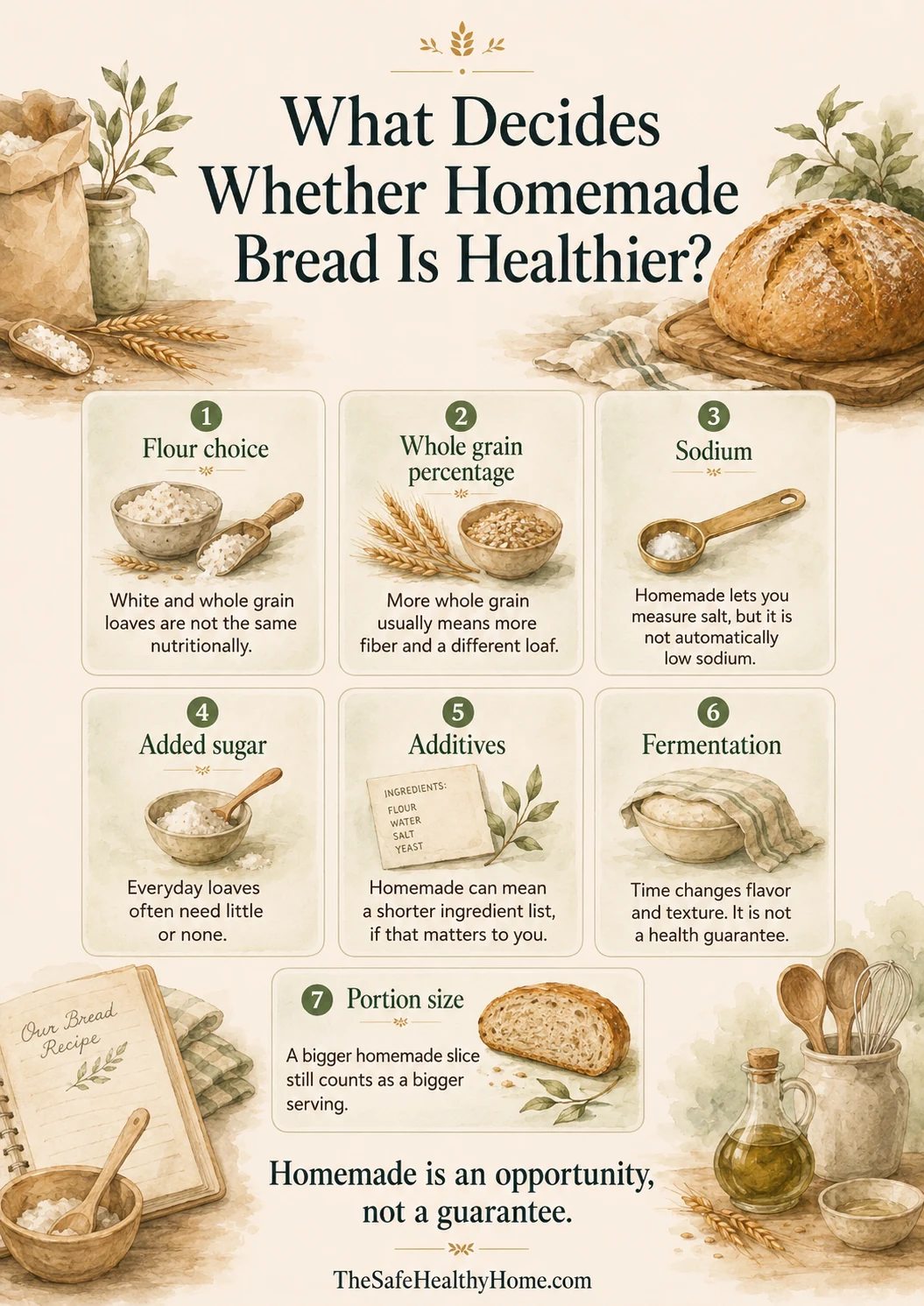
Homemade bread is healthier when it gives you better control over the things that actually matter: flour, whole grains, sodium, added sugar, additives, fermentation, and portion size. It is not healthier by default, and the word homemade does not do any nutritional work on its own.
The best bread is the one that fits your real diet, not an idealized picture of what homemade should be. Sometimes that is a whole grain loaf from your own oven, warm and exactly the way you wanted it. Sometimes it is a well-chosen loaf from the shelf on a busy week. Both can be a sound part of how you eat, and knowing the difference is what lets you choose well.
FAQ
Is homemade bread healthier than store-bought bread?
It can be, but not automatically. Homemade bread gives you control over flour, salt, sugar, additives, fermentation, and portion size. A loaf made with that control in mind can be healthier. A homemade white loaf is not meaningfully better than a store-bought white one.
Is homemade bread lower in calories?
Not necessarily. A dense, hand-shaped loaf can carry more calories per slice than thin packaged sandwich bread, mostly because the slice is bigger. Homemade is not automatically lower in calories or carbohydrate, so portion size still counts.
Is sourdough bread healthier than regular bread?
Sometimes, in specific ways. Long fermentation can reduce phytate and may improve mineral absorption, and some studies report a gentler blood sugar response with certain sourdough breads. But the evidence is mixed and depends on the flour, fermentation, and recipe. Choose it for flavor and texture, not as a health guarantee.
Is sourdough gluten-free?
No. Ordinary sourdough is not gluten-free and should not be treated as safe for celiac disease unless it has been specifically made and verified as gluten-free.
What is the healthiest flour for homemade bread?
For most people, moving some or all of the loaf toward whole grain is the strongest upgrade, because it keeps the fiber and nutrients in the outer layers of the grain. Enriched white flour is not empty, since some nutrients are added back, but it does not match a true whole grain.
Does homemade bread have less sodium?
It can, because you measure the salt yourself. Salt also supports flavor, fermentation, and structure, so the aim is to keep it measured and intentional rather than to remove it.
Does the water you use for bread matter?
For health, almost certainly not, and tap water is usually fine. Water can affect how dough behaves and how a sourdough culture performs, especially with heavy chlorination or chloramine. If a starter keeps struggling or the dough is inconsistent, water is a reasonable thing to test, more for consistency than for safety.
Is homemade bread better if it has no preservatives?
A shorter ingredient list is a fair preference, and home baking gives you that. That does not prove packaged-bread ingredients are harmful. Food additives and GRAS ingredients are meant to meet safety standards for their intended uses, but the simpler loaf may still be the one you prefer.
Can homemade bread be part of a healthy diet?
Yes. Bread made with good flour, reasonable sodium, modest added sugar, and a sensible portion fits comfortably into a healthy diet, especially paired with protein, fiber, and good fats rather than eaten as the whole meal.